Urban Economy Video, Victor Vroegindeweij, Building for Brussels exhibition, BOZAR, 2010 Why does the dominant urban development culture drive the local manufacturing economy and logistics out of the city? While the rate of unemployment in cities is so high, and the city is the main market for goods?   
Building for Brussels Publication, Editions Parenthèses, 2012 One chapter of the book was devoted to the question: how can architecture support the local economy? A new, urgent work field had been exposed.   
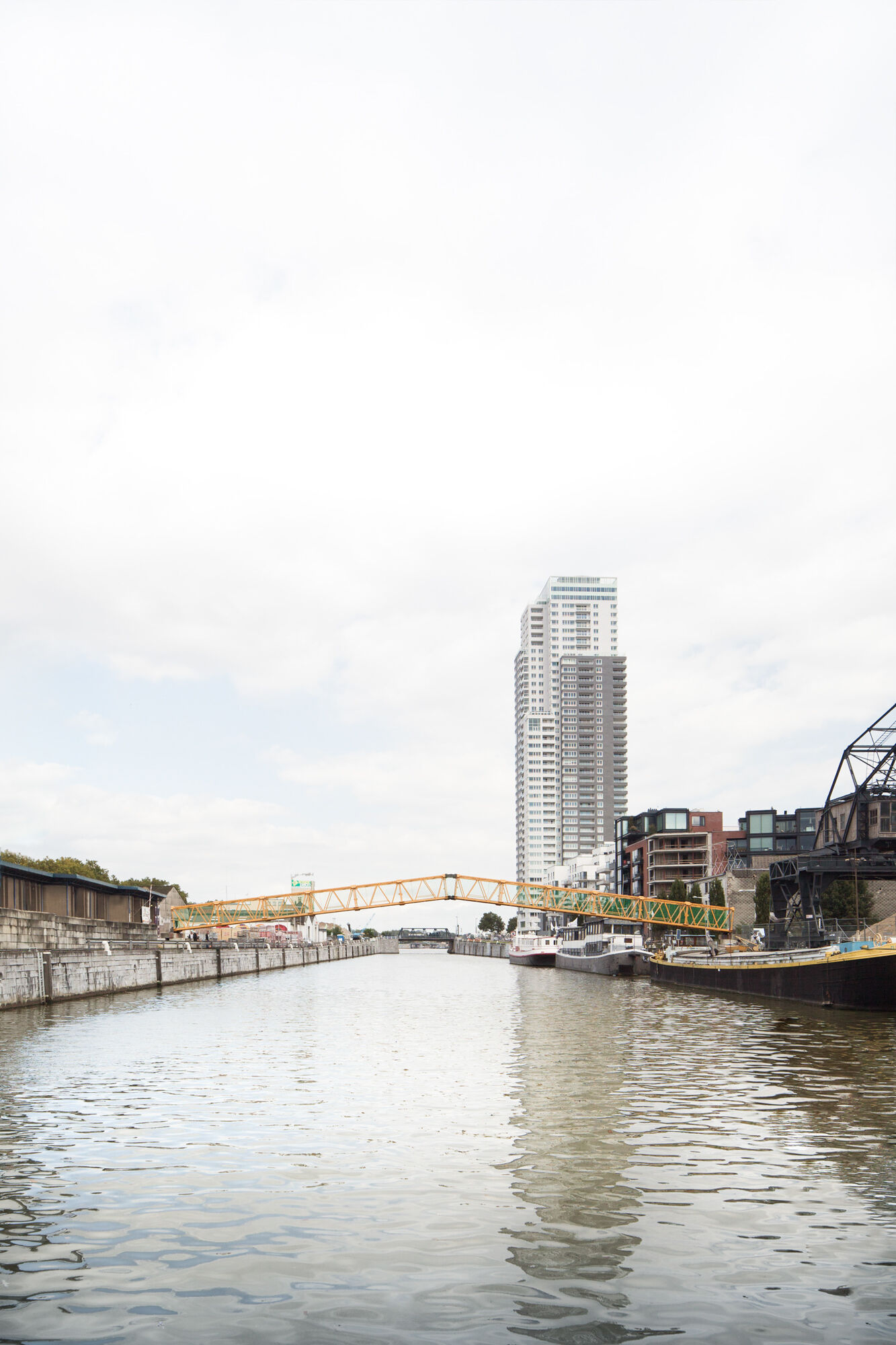
Bridge, Gijs Van Vaerenbergh, Festival Kanal Play Ground, Brussels, 2014. The temporary pedestrian bridge spanning the canal, designed by Gijs Van Vaerenbergh, connects the city of makers to the city of thinkers.
Atelier Brussels The Productive Metropolis, video, Storyrunner, 2016. While we primarily viewed our home city of Brussels as a city with hundreds of problems, Brearley called it a ‘city of miracles’. In Brussels, unlike other European cities, there is still a lot of industry, and, as Brearley says: A Good City Has Industry!    
Installation views 'IABR–2016-The Next Economy', 2016, IABR, Rotterdam. Photo: Filip Dujardin During a three-month period, we organised lectures, debates, guided tours and design ateliers almost daily. iabr.nl It allowed us to increase the enthusiasm of a broad audience of policy-makers, professionals, academics and students with regard to the new vision of the productive city.  
A Good City Has Industry, Visitor Guide, 2016. Visitor guide from A Good City Has Industry, with ten rules of thumb for building the productive city.    
Picture Series 'Atelier Brussels', 2015, Brussels. Photo: Bas Bogaerts Unlike many other European cities, there is still a lot of economic activity and industry embedded in the urban fabric of Brussels.   
Urban Metabolism of the Brussels Region - Interview with Olv Klijn of Fabric, 2016. Fabric considers a city to be a living 'metabolism'. The ultimate goal is to create a circular city. This is a city where all the different flows are optimally aligned and as few precious raw and other materials and energy as possible are lost.   
Work models for the Productive City, research by design, Plusoffice + WRKSHPS, Atelier Brussels, 2016 How do we design space for the many businesses in productive districts? The Tinker Tower makes production prominently visible in the public space. It celebrates industry in the city and restores the pride of manufacturing.   
De Lage Landen 2020-2100, 2014-2017 Fossil-free neighbourhoods are an important link in a broader transition to renewable energy. In the publication Lage Landen 2020–2100. Een toekomstverkenning (2017), we set out how energy neighbourhoods, energy generation in rural areas and large-scale supergrids will together form a single (spatial) system. 
'(re) Productive City', animated film, You Are Here, 2018 The transition to a circular economy represents an opportunity to transform our cities into circular and sustainable cities. The animated film shows how we can accelerate this transformation through highly specific projects and reduce the impact of economic activities on our planet.  
Maarten Gielen, Rotor, interview, You Are Here, 2018 Maarten Gielen is one of the pioneers in Europe in the field of the circular economy. Rotor harvests materials from buildings destined for demolition to reuse them elsewhere. The materials are kept as close as possible to their original state so that minimal energy is lost.  
Circular City Ports, synthesis, 2019. Our ports play a central role in the transition to circular cities. With the transition to a circular economy and the return of production to our cities, the ports will be assigned a new function: as energy generators, material banks, recycling yards or as the basis of new maritime economies.     
Kortrijk 2025. De stad die we kunnen willen, publication, 2018. In Kortrijk, we organised an ambitious participative project together with the city council, in which hundreds of citizens jointly decided the future of their city. The city's many abandoned industrial buildings are assigned a new purpose to accommodate the urban economy of the future.     

Credits

Text: Roeland Dudal (AWB) en Joeri De Bruyn (Public Space)

This narrative is largely based on the research developed in the framework of the Atelier Brussel - Productive Metropolis.

Atelier Master: Mark Brearley, Cities research group at London Metropolitan University and Kaymet, London

Partners: IABR, Brussels-Capital Region, Ruimte Vlaanderen, OVAM and the Province of Flemish Brabant

Design teams: Plusoffice Architects/ WRKSHP collective, CENTRAL/ Eva Le Roi/ Maxime Delvaux, URA architects, Spacelab.be, Fabric/ ULB (LoUIsE and BATir)/ Circular Economy


EN FR NL
WORKROOM

Since 2010, Architecture Workroom Brussels has focused on the future of our living environment. The organisation began as a safe haven to address the link between space and societal transitions, aimed at fostering a futureproof design practice, commissioning and building culture.

It has now become evident that the transformation of our streets, neighbourhoods, and landscapes is both a prerequisite and a lever for achieving societal goals in synergy. Yet we observe that these transformations remain difficult to imagine and implement. They span so many sectors and involve so many actors that responsibility falls on everyone, and therefore, ultimately, on no one.

That is why we make it our mission to create the space that connects them. And with this refined mission comes a new name: WORKROOM, House for transformation. WORKROOM is the shared space where the future of our living environment is not only imagined but also organised.

We are currently taking the lead on three mission-driven transformations:

  • SOCIETAL INCUBATORS - By 2030, stakeholders from the youth, culture, sports, care and education sectors will join forces to create renewed societal spaces that tackle loneliness and counteract the fragmentation and pressure on public infrastructure.
  • FOSSIL-FREE NEIGHBOURHOODS - By 2030, at least ten neighbourhoods will be underway with the transition to fossil-free energy in an inclusive and affordable way, with a view to completely phase-out fossil fuels by 2040.
  • SPONGE LANDSCAPES - By 2030, we will have achieved our water, agriculture and nature goals through a single, coherent approach at catchment area level, in which strong regional coalitions collectively enhance the landscape's sponge capacity.

To make these transformations a reality, WORKROOM works shoulder to shoulder with pioneering designers, local authorities, organisations and businesses, governments, knowledge institutions and impact investors.

Through co-creative design, we imagine shared pathways to the future in exhibitions, publications, innovation programmes and public programmes. These are the workrooms where we connect the actors capable of realising these transformations. From there, we design shared ownership and the organisational, funding and policy models that lead to real change.

The name is simpler. The stakes are higher. WORKROOM is the shared space where we tackle the social and spatial transformations that no one can achieve alone. In an era of polarisation, compartmentalisation and instability, that is perhaps the most radical thing we can do.