News
Who heats the city? opening night
9. Oct 2026
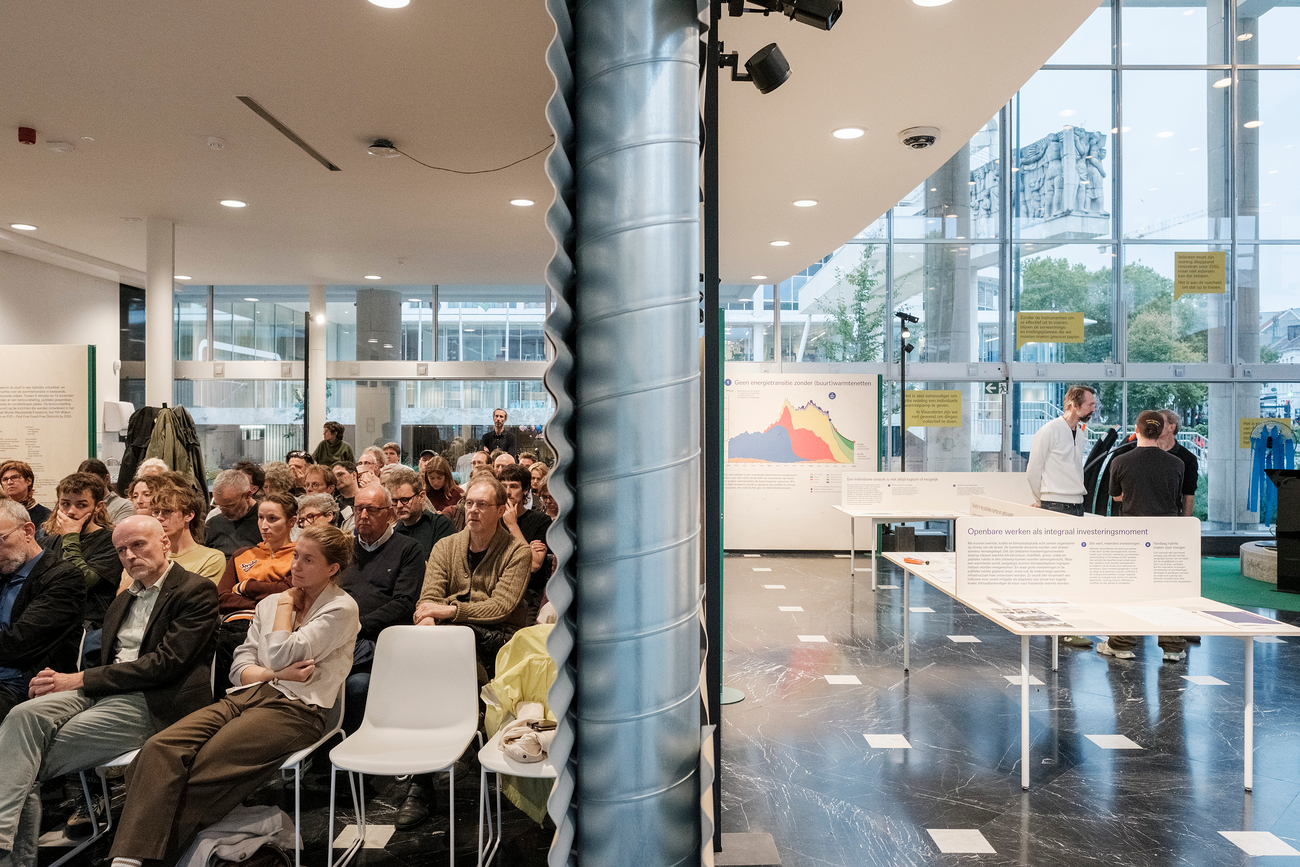
On 9 October, the exhibition ‘Who Heats the City?’ opened its doors. The festive opening began with the first guided tours of the exhibition and a preview screening of the documentary of the same name. We then explored the heat transition in existing neighbourhoods during two panel discussions: who is currently taking the lead in heating the city? And what does a strategy for scaling up look like?
With Anne-Maria Vandenbroucke (Warm90/50), Iris Van den Abbeel (Urban Regeneration Department, City of Ghent) and Jo Neyens (ODE / Warmtenetwerk Vlaanderen), we learnt how the heat transition is already taking shape in practice today. We explored the benefits of district heating networks as a logical choice in existing neighbourhoods and how residents’ groups are themselves putting the pieces of the jigsaw together to achieve fossil-free heating. But they cannot do this alone: “Citizens can take the lead and show interest, but they are not expected to bear the investment risks themselves.” The early involvement of major players, such as property managers and local authorities, helps to spread the risks fairly and offers opportunities to design other measures in tandem – such as resurfacing roads and upgrading sewerage systems – resulting in a more resilient and healthier neighbourhood.
The documentary Who Heats the City? brings together different perspectives on the heat transition. Hartwin Leen explains why this is working in new-build neighbourhoods but not yet in existing ones. Britt Verhesen outlines what is needed to scale up this initiative, and Gilles Guillaume demonstrates how all residents can be involved in this transition.
In the second round of discussions, we moved on to the supporting framework with Britt Verhesen (Project Leader for Sustainable Heating, City of Antwerp), Johan Albrecht (Professor of Environmental Economics, Ghent University) and Filip Watteeuw (Alderman for Housing, Environment, Climate and Energy, City of Ghent). How do we give the heating transition a robust foundation, moving beyond ad hoc funding and competitive schemes? “Politicians think in terms of pilot projects, but we need to think in terms of transformation.” This shift requires more than just additional resources. It calls for imagination: new forms of collaboration, new agreements between the city, residents and developers, and new ways of organising shared risks and benefits. Pioneering local authorities are already drawing up these rules today, for example by exploring how a city can act as a co-guarantor for heat procurement, or by taking the pressure off residents who cannot afford renovation work.
Already today, coalitions of residents’ groups, local authorities, property managers and heating developers are working together to draw up heating plans for their neighbourhoods. But a plan on paper does not yet provide the scope for action. To date, no one has the mandate to phase out gas and kick-start the transition to fossil-free heating. Moreover, we regard projects whose investments do not pay for themselves in the short term as failures, whilst we do not have that reflex when it comes to other major collective infrastructure projects – cycle paths, railways, sewerage systems. To get collective heating off the ground, we must look beyond the financial picture: it is a social project with many benefits.
Both the documentary and the exhibition convey the same message: no single actor can shoulder the collective heating transition alone; it requires a social deal between parties, each of whom holds a part of the solution. That is why Who Heats the City? lays the pieces of the puzzle on the table. The challenge now is to connect them into a single implementation model, so that fossil-free heating reaches full speed by 2030 in existing neighbourhoods across Flanders.


