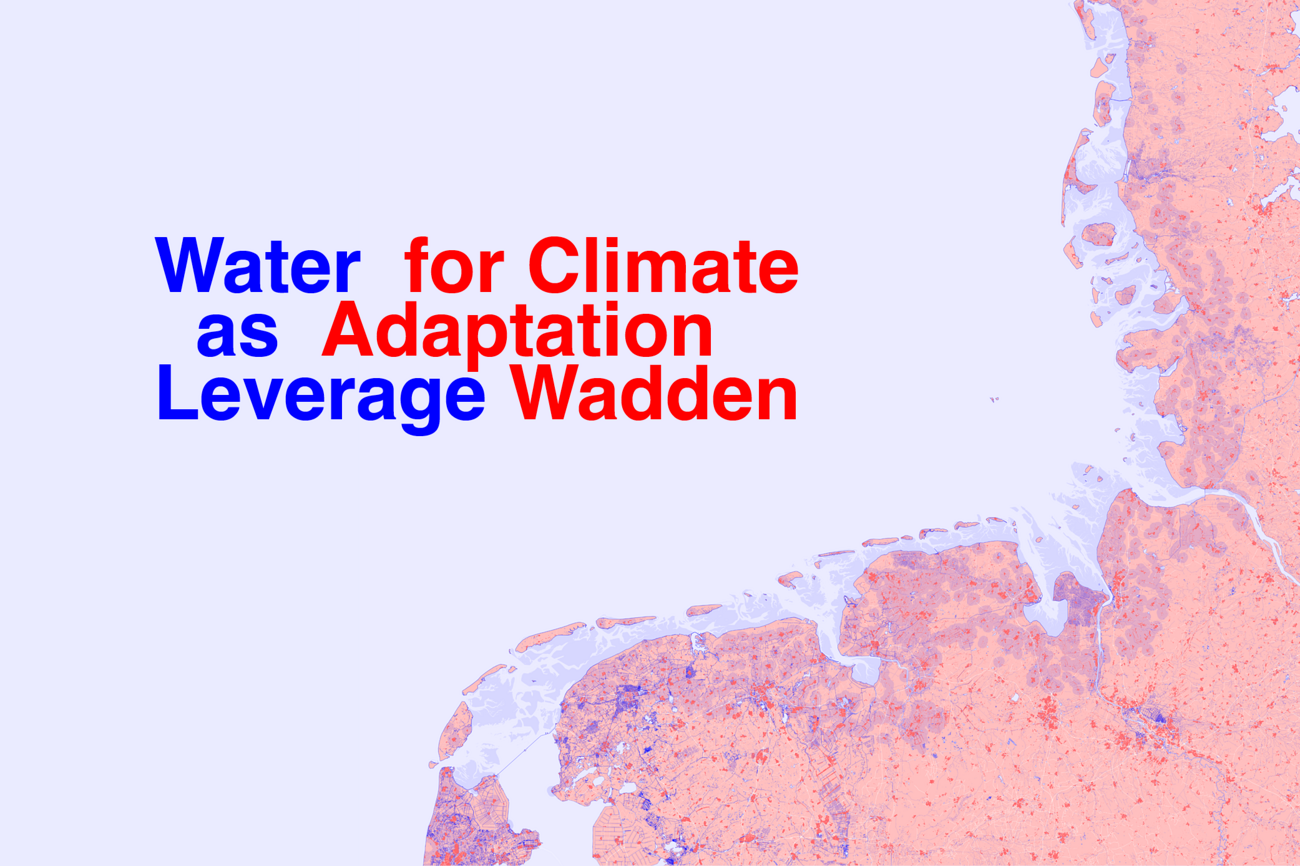
The Wadden Sea is the largest tidal flat ecosystem in the world, full of nature and culture. At the same time, the consequences of climate change are a daily reality. This makes the area the ideal test-site for the Water as Leverage method. The call book Water as Leverage – Wadden describes the situation in seven areas around the Wadden Sea, maps the challenges and leads the way towards climate resilient solutions. 

Water is often considered a threat, that we must guard ourselves against. However, we can also interpret the big influence of water in a positive sense. Water can be a catalyst for spatial, social, and climate-related processes. For example, a good relationship and handling of water restores biodiversity, gives us more breathing space, and ensures a healthier soil. The Water as Leverage approach therefore does not see water as a threat, but rather as a lever.

The Wadden Sea was the next test site for the Water as Leverage method, previouly applied to water issues in three Asian coastal and delta cities. This is the largest tidal flat ecosystem in the world, spread across the Netherlands, Germany, and Denmark. The area is full of natural and cultural qualities, biodiversity, and opportunities for water. At the same time, it is an area in which the effects of climate change are a daily reality: heavy rainfall in short periods, temperature increases, and sea level rise are pressing issues. These challenges are paralleled by other issues, such as tourism, heritage conservation and various transitions in port areas. How can we protect the Wadden Sea and revive its richness? The Wadden Sea is calling for action!

Seven local communities were part of Water as Leverage – Wadden: Texel, Terschelling and Harlingen in the Netherlands, Emden in Germany and Ribe, Esbjerg and Fanø in Denmark. The recently published Setting the Scene document examines the shared and individual challenges faced by the areas and presents the needs and focus for an approach.

Read the full call book

More News
EN FR NL
WORKROOM

Since 2010, Architecture Workroom Brussels has focused on the future of our living environment. The organisation began as a safe haven to address the link between space and societal transitions, aimed at fostering a futureproof design practice, commissioning and building culture.

It has now become evident that the transformation of our streets, neighbourhoods, and landscapes is both a prerequisite and a lever for achieving societal goals in synergy. Yet we observe that these transformations remain difficult to imagine and implement. They span so many sectors and involve so many actors that responsibility falls on everyone, and therefore, ultimately, on no one.

That is why we make it our mission to create the space that connects them. And with this refined mission comes a new name: WORKROOM, House for transformation. WORKROOM is the shared space where the future of our living environment is not only imagined but also organised.

We are currently taking the lead on three mission-driven transformations:

  • SOCIETAL INCUBATORS - By 2030, stakeholders from the youth, culture, sports, care and education sectors will join forces to create renewed societal spaces that tackle loneliness and counteract the fragmentation and pressure on public infrastructure.
  • FOSSIL-FREE NEIGHBOURHOODS - By 2030, at least ten neighbourhoods will be underway with the transition to fossil-free energy in an inclusive and affordable way, with a view to completely phase-out fossil fuels by 2040.
  • SPONGE LANDSCAPES - By 2030, we will have achieved our water, agriculture and nature goals through a single, coherent approach at catchment area level, in which strong regional coalitions collectively enhance the landscape's sponge capacity.

To make these transformations a reality, WORKROOM works shoulder to shoulder with pioneering designers, local authorities, organisations and businesses, governments, knowledge institutions and impact investors.

Through co-creative design, we imagine shared pathways to the future in exhibitions, publications, innovation programmes and public programmes. These are the workrooms where we connect the actors capable of realising these transformations. From there, we design shared ownership and the organisational, funding and policy models that lead to real change.

The name is simpler. The stakes are higher. WORKROOM is the shared space where we tackle the social and spatial transformations that no one can achieve alone. In an era of polarisation, compartmentalisation and instability, that is perhaps the most radical thing we can do.