Houses for the common good are the places where together we care, learn, meet, organise, find support and belong. The collective resources that make society. The third edition of the open workroom addresses the loss of public infrastructure and changing societal questions together to support a radical and necessary shift: from a building stock trapped in sectoral logics and no longer matching today’s needs, to a dynamic network of societal infrastructure driven by local demand.
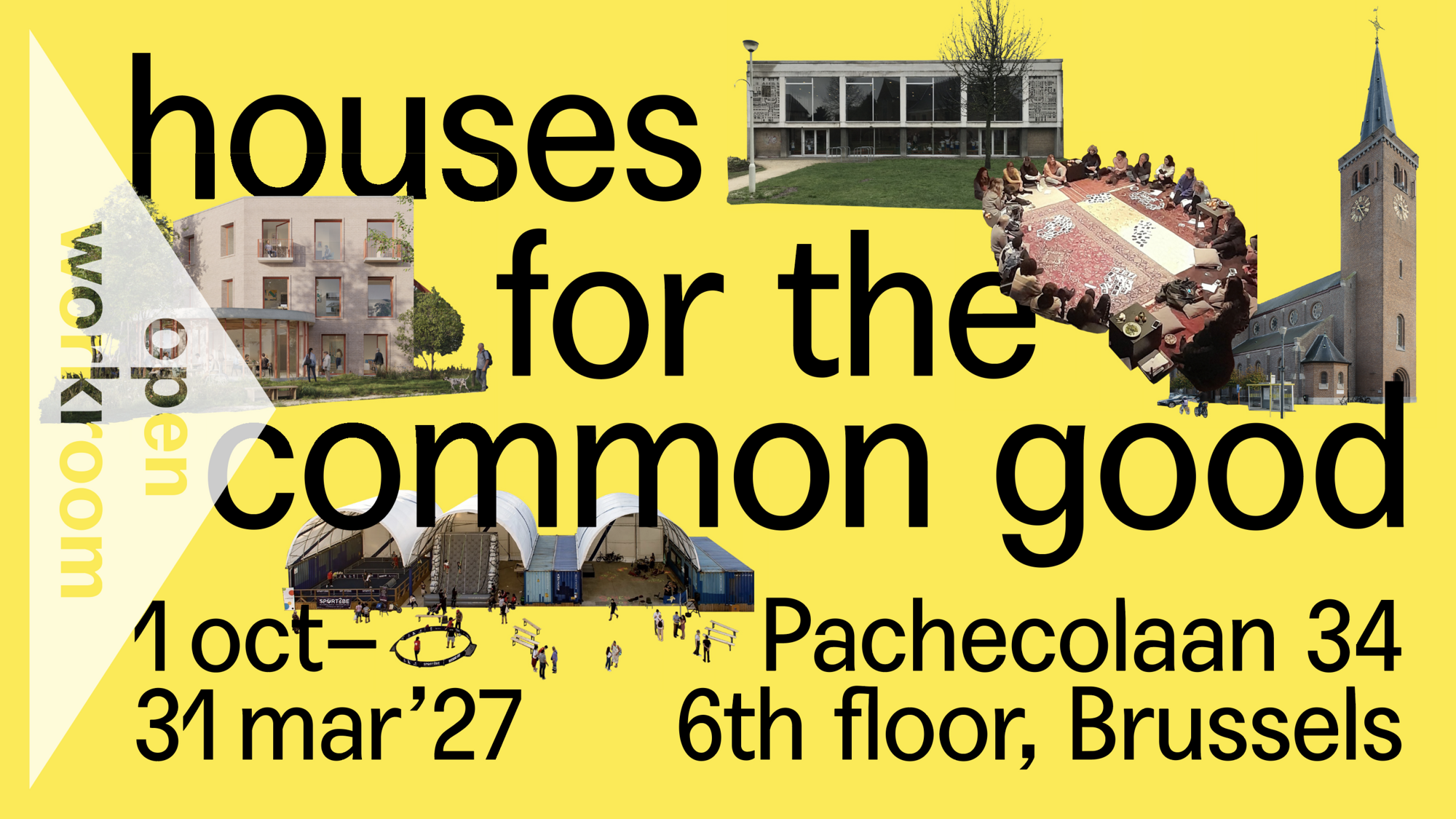
Renovating our community infrastructure is a major challenge. Not just physically, but because its original programmes rarely fit today's needs, pushing more public real estate onto the private market. Meanwhile, in an increasingly diverse, ageing and individualised society, demand for places proximity, encounter and community keeps growing. Two forces are pulling in opposite directions, each one making the other more urgent.
The third edition of the open workroom takes as its mission to build the collective strategy that can turn this double trend around.
Five inspiring projects point the way: de Boomgaard, Molenwest, Globe Aroma, the Holy Cross Church of Boekhoutte and the Patrimoniumscan (translates to building-stock scan) of the village core Aartselaar are portrayed by filmmakers Bertrand Lafontaine and Michael Lombarts. The video documentaries reveal how Houses for common good become possible: not from sectoral goals, but from who uses the space, who shapes it, how it adapts to local needs, who owns it, who pays for it, and who keeps it alive.
Together with the Nine keys for future-oriented societal infrastructure, they form the basis for the exhibition, allowing us to collectively sketch the conditions to realise Houses for the common good beyond one site, one coalition or one opportunity.
PROGRAMME
Yes indeed, just as the last two editions (operation energy neighbourhoods and sponge landscapes), the open workroom invites you to roll up your sleeves and join in! The open workroom functions as a setting for a programme of closed workshops and public talks.
A series of four public talks forms the framework for the open workroom's programme. The people driving the exhibited projects present their practical or research experience, followed by a roundtable discussion that allows us to co-envision the strategy to realize many Houses for the common good.
Thursday October 1st, 2026 – March 31st, 2027
Visit the exhibition for free on open Thursdays between 10:00 – 18:00 or request a guided tour for your group.
Thursday October 1st, 2026 – OPENING NIGHT
18:00 – Guided tours
19:00 – Beyond the brief: Designing Houses for the common good [register here]
What does it mean to design Houses for the common good? Beyond designing with materials, structures and technical solutions alone, a thorough understanding of local needs and societal questions is fundamental to shaping the physical space for a community of users. New relationships between client, designer and user are transforming the role of architects. Thinking outside the rigid lines of the CAD drawing, they bring together user coalitions and explore actual needs through co-creative processes. The design becomes intertwined with organisational and financial strategies. Throughout, the principle of sufficiency, or the ‘economy of enough’ is guiding: how do we create buildings that are sufficient for today and adaptable for the future? Through various cases, examples, we explore Houses for the common good as a new design practice.
Tuesday November 17th, 2026
18:00 – Guided tours
19:00 – A house of many: the economics of collective ownership [register here]
Thursday February 18th, 2027
18:00 – Guided tours
19:00 – Not just bricks: empowering the people’s work [register here]
Thursday March 18th, 2027
18:00 – Guided tours
19:00 – For the common good: setting targets for a post-sectoral strategy [register here]
PARTNERS
The open workroom Houses for the common good builds on the insights of project initiators, public authorities, civic organizations, funding organizations, designers, developers, users, and communities. Both the programme and the exhibition could only take shape thanks to the valuable contributions of the quality committee that accompanied its development: Peter Bosschaert (De Ambrassade), Bertrand Lafontaine (Architectura), Gunter Bousset (Team Coördinatie Brussel), Inge Van de Walle (Cultuur OP/TIL), An-Sofie Gysemans (Cultuur OP/TIL), Elke Verhaeghe (De Federatie), Bart Verhaeghe (De Federatie), Winnie Poncelet (Found&Fuel), Roel De Ridder (Platform Toekomst Parochiekerken), Eva De Baerdemaeker (PLEK-WERK), Kätti Robb (perspective.brussels), Caroline Englebert (VGC), Christophe Cousaert (VIPA), Eline Aerts (Team VlaamsBouwmeester) and Jim Segers (City Mine(d)).
The open workroom is an initiative by Workroom in close collaboration with PLEK-WERK, with the support of the Flemish Government, Department of Culture.
Would you like to become a partner or contribute to the open workroom programme? Contact us: openworkoom [at] workroom.org
