News
The renovation race to 2030: from a standstill to acceleration
25. Apr 2025
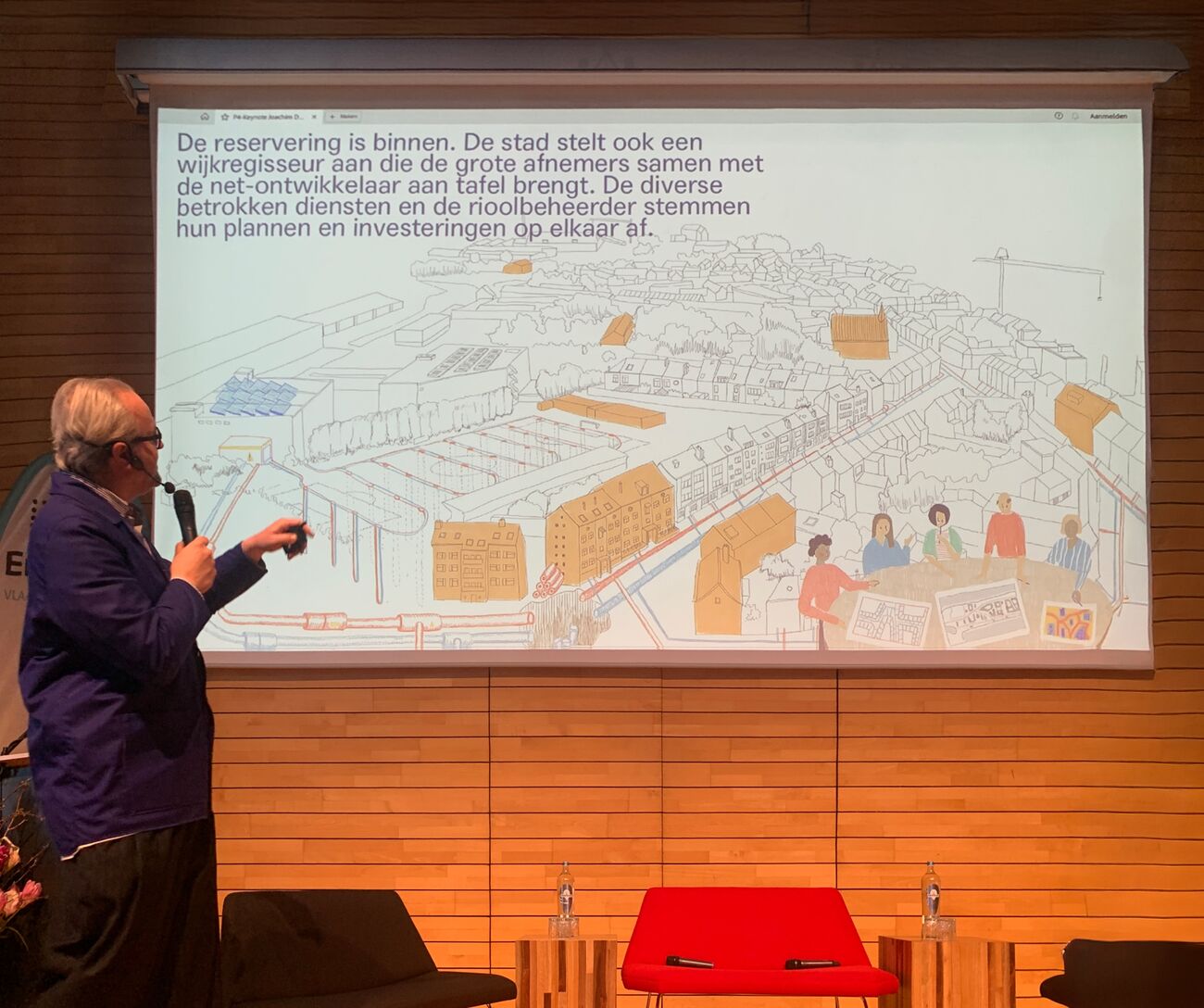
The invitation to speak at the 16th energy conference ‘The Renovation Race to 2030’, organised by Embuild Flanders and Flux50, provided the impetus for AWB’s Energy Team to fine-tune the lessons learned from its ongoing energy-related projects - the 100 Neighbourhoods Platform, the Living Lab Muide Meulestede and the Open Workroom programming - and transform them into a coherent narrative.
The presentation is based on an actual neighbourhood. Let’s examine the renovation race through the eyes of a resident. Take 75-year-old Agnes. She lives alone in a large house and only has the heating on downstairs. Her electricity bill is low - after all, she only heats her living space - and renovation costs are very high: it would take more than a hundred years to recoup that investment. Hamza and Fatima have no renovation plans either: they don’t have enough capital to make the investment, even with the support currently available. Evi and Yves have just invested in extensive renovation work to the property they bought, but because of soaring electricity costs, they opted for an economical gas boiler instead of a heat pump. Another family calculated that if they made a major investment right now, the financial benefit would not be much more than if they delayed the renovation for another ten or twenty years. Ayala and Michiel do see the need for fossil-free heating, but their ground-floor corner apartment does not have enough space to install a heat pump.
Current policy seems to expect owners to take responsibility in the renovation race. But the tools that support that policy, such as grants for renovations, offer insufficient incentive to those not considering renovation in the first place, and too little support for those who need it most. Ayala and Michiel’s story shows that the house-by-house logic also has to contend with spatial limitations. Could collective systems provide a methodology worth exploring to help us get to the finish line of the race in a more integral, inclusive, economical and efficient manner?
Several municipalities have already made good progress in exploring the possibilities of an approach that involves collective heat and renovation. However, they come up against a regulatory framework that doesn’t support this innovation but impedes it. Local governments, supralocal authorities, experts and citizens are stuck with a wait-and-see attitude: the Flemish Government is waiting for successful projects to establish a framework, but local governments will not succeed in getting heat developers on board if there is no adequate legal and financial business case.
It’s time to make a ‘deal’ and establish a level playing field. Can we get the first generation of fossil-free heating systems off the ground in existing neighbourhoods between now and 2030, adjust policy accordingly as we go along, and support 100 neighbourhoods from the outset? Designing and implementing such a breakthrough programme requires various actors and disciplines to pool knowledge and insights and exert their influence.
In late 2024, AWB (innovation house for transformation) and VITO (technological research centre), along with a coalition of local initiators, launched their own trajectory in order to examine the form the programme should take and whether there is support for it. By the summer of 2025, we want to draft a proposal for this breakthrough programme, ideally supported by a strong coalition. Want to stay informed, have an idea or make a contribution? Get in touch!


