News
A fruitful harvest for the 100 DISTRICTS PLATFORM
27. Apr 2023
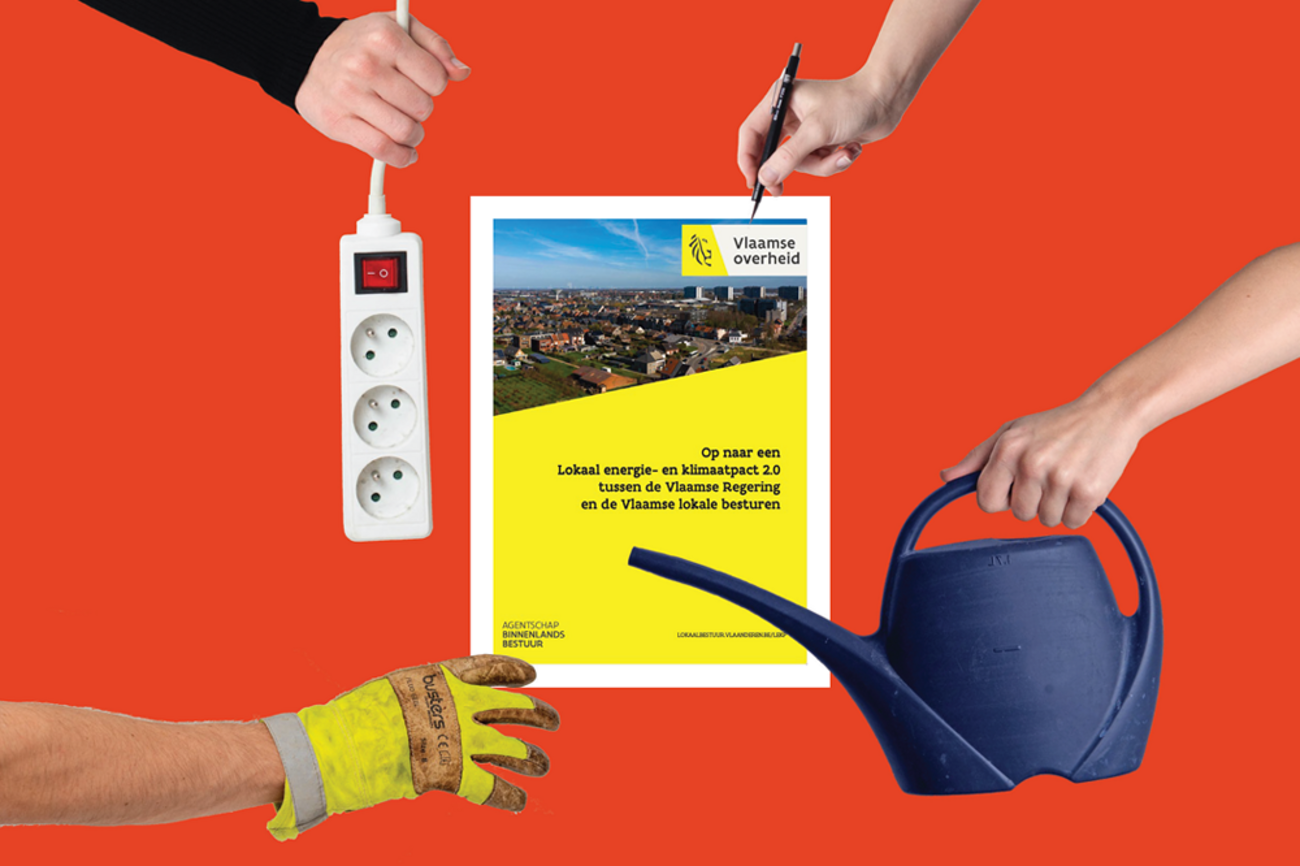
The coming two to four years, the 100 DISTRICTS PLATFORM will support Flemish municipalities to realise the goals of the Local Energy and Climate Pact (LEKP) in specific neighbourhoods. During the LEKP congress on 18 April 2023, we presented three work programs on which the municipalities will be focusing.
During the LEKP harvest session on 8 March 2023 we collected the needs and opportunities for 60 Flemish municipalities and other organisations. We harvested 13 working points. Three overarching work programmes bring together all the points that municipalities, local actors, experts, Flemish governments, and umbrella associations will investigate the coming years:
Work programme 1: “Pearl of the heating network”
The objective of this work programme is to test whether an entire neighbourhood can switch to fossil-free heat at the same time. The construction of the energy infrastructure can thereby leverage the collective renovation of the (individual) houses. But who owns the network and how will it be financed? Within which legal structures can public, private, and civil land, investment and capacity be bundled? What strategies are effective to connect groups of homes incrementally or all at once? How do you align timing with that of other themes, such as dehardening and mobility?
Work programme 2: “Everyone aboard!”
In this work programme, we test a public-private-civic cooperation model around integrally de-caring various groups of residents and users in the neighbourhood, for the profound transformation of their homes, gardens, and streets. Can municipalities develop a de-caring package 2.0 which offers renovation advice, connection to renewable energy, a loan and a pool of quality architects and contractors through one contact hub? What activation strategies can effectively reach all residents in a neighbourhood? Can climate tables be used for this purpose, and how? How should regulations be adapted, e.g. to make collective licensing easier?
Work programme 3: “Streets towards the future”
This work programme investigates the synergy between a proactive mobility policy on the one hand, with a focus on electric (partialshared) mobility, neighbourhood car parks or double use of existing private car parks, and the climate adaptation of streets and squares on the other. This requires cooperation between different departments within local governments, private parties, and supra-local actors. What agreements can be made with schools or supermarkets to use underused car parks as neighbourhood parking? Should covenants with utility operators be established to link incrementally greening and dehardening to planned investments in public spaces? Which design solutions are possible to simultaneously make room for trees, heat networks and segregated sewage networks in our subsurface?
Architecture Workroom Brussels is part of the consortium of the 100 DISTRICTS PLATFORM, together with 3E, Flux50, The New Drive and Plant and Houtgoed.


