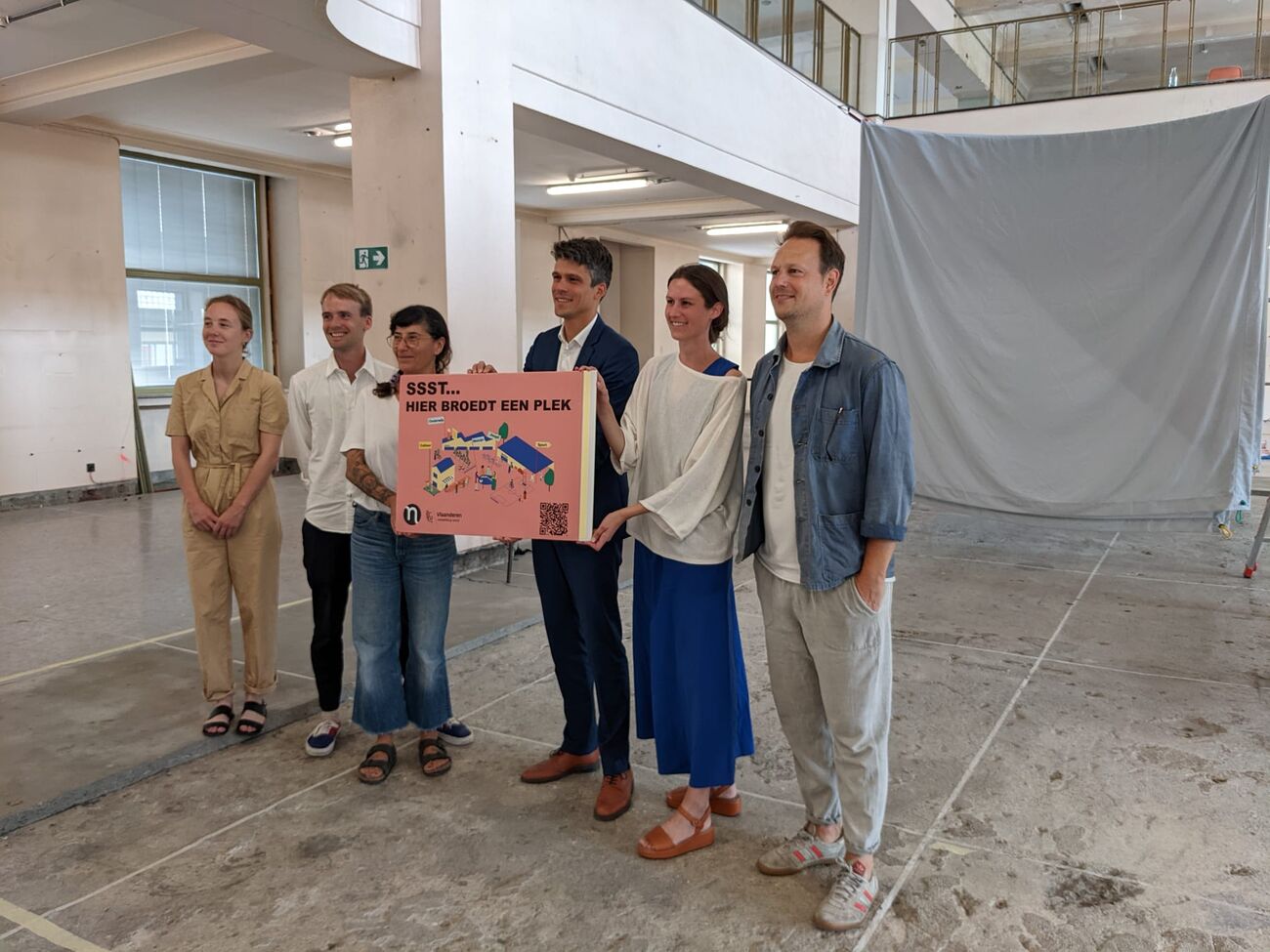
12 ‘Broedplekken’ approved for Brussels, June 2022

Who helps to build the city and society of tomorrow? To answer the many societal challenges of today, we need physical space in the city. Many organisations are looking for a space to locate themselves, without success. At the same time, there are organisations that have space available, in which they would like to house creative and social partners. However, they are still lacking a network to find connections like these.

As an answer to this gap, the Flemish government released the call for projects ‘Gemeenschapsinfrastructuur als Broedplek in Brussel’, to connect Brussels organisations, focusing on a (cross)sectoral collaboration across community responsibilities. After an intensive working process towards the submission of subsidy applications, twelve plans for breeding sites got approved. In 2023 we will further support the selected sites to learn from the trajectory and from each other.

‘Broedplekken’ (‘breeding sites’) are working grounds existing of bricks and people, in which local communities and organisations build on new collaborations, by means of which they can provide answers to societal challenges in Brussels. In these physical spaces, they empower each other’s functions, develop new initiatives, and plant the seeds for urban future places.

Architecture Workroom has taken on a coordinating role in guiding the subsidy applications. In the first phase, we matched organisations according to their wishes and needs. By organisations a matchmaking session, we connected the organisations with each other, facilitating their search for possibilities to share their infrastructure. Together with the clusters of matched organisations, we worked towards concretising and sharpening their subsidy applications, together with a pool of spatial, financial, and organisational experts. In the summer of 2022, twelve proposals for new ‘breeding sites’ in Brussels were approved.

In 2023 we will commence a new trajectory with the selected infrastructures. Our goal is to develop a future-proof framework and methodology to further develop more efficient and purposeful ways of tackling the many societal, social, and spatial challenges in Brussels.

More News
EN FR NL
WORKROOM

Since 2010, Architecture Workroom Brussels has focused on the future of our living environment. The organisation began as a safe haven to address the link between space and societal transitions, aimed at fostering a futureproof design practice, commissioning and building culture.

It has now become evident that the transformation of our streets, neighbourhoods, and landscapes is both a prerequisite and a lever for achieving societal goals in synergy. Yet we observe that these transformations remain difficult to imagine and implement. They span so many sectors and involve so many actors that responsibility falls on everyone, and therefore, ultimately, on no one.

That is why we make it our mission to create the space that connects them. And with this refined mission comes a new name: WORKROOM, House for transformation. WORKROOM is the shared space where the future of our living environment is not only imagined but also organised.

We are currently taking the lead on three mission-driven transformations:

  • SOCIETAL INCUBATORS - By 2030, stakeholders from the youth, culture, sports, care and education sectors will join forces to create renewed societal spaces that tackle loneliness and counteract the fragmentation and pressure on public infrastructure.
  • FOSSIL-FREE NEIGHBOURHOODS - By 2030, at least ten neighbourhoods will be underway with the transition to fossil-free energy in an inclusive and affordable way, with a view to completely phase-out fossil fuels by 2040.
  • SPONGE LANDSCAPES - By 2030, we will have achieved our water, agriculture and nature goals through a single, coherent approach at catchment area level, in which strong regional coalitions collectively enhance the landscape's sponge capacity.

To make these transformations a reality, WORKROOM works shoulder to shoulder with pioneering designers, local authorities, organisations and businesses, governments, knowledge institutions and impact investors.

Through co-creative design, we imagine shared pathways to the future in exhibitions, publications, innovation programmes and public programmes. These are the workrooms where we connect the actors capable of realising these transformations. From there, we design shared ownership and the organisational, funding and policy models that lead to real change.

The name is simpler. The stakes are higher. WORKROOM is the shared space where we tackle the social and spatial transformations that no one can achieve alone. In an era of polarisation, compartmentalisation and instability, that is perhaps the most radical thing we can do.