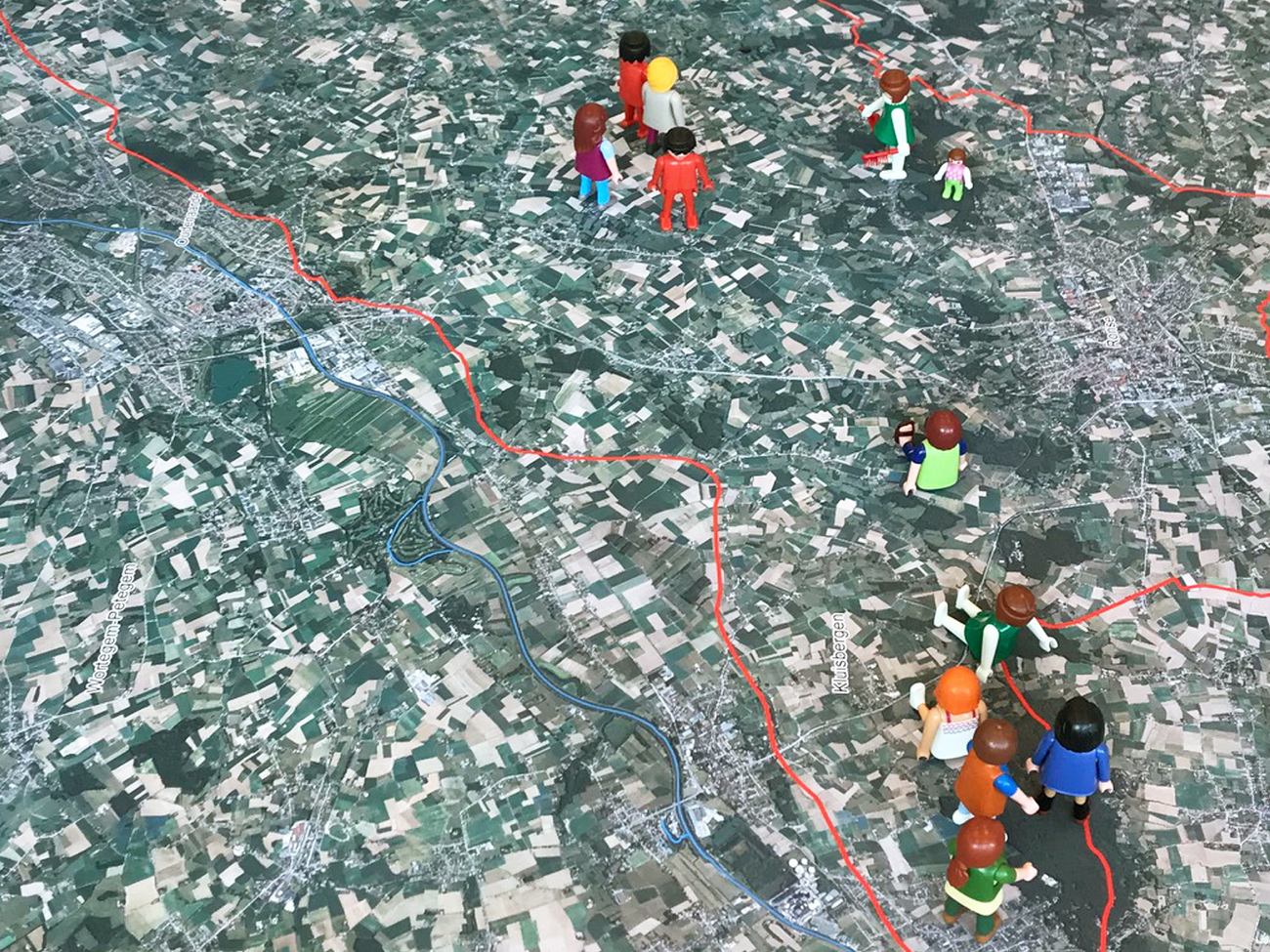
Introduction during a local facilitation day

Landscape parks are vast areas in which the interaction between humans and nature creates a unique, valuable landscape. Important aspects for a landscape park are the quality of the landscape and the interwovenness of the different applications of the area. The development of the landscape, recreation, nature, heritage, agriculture, housing, activities, and tourism go hand in hand.

In the coming year, three Flemish regions can get the label of ‘Landscape Park’, which will include official recognition and financial funds. Before the summer of 2023, the Zwinstreek, the Flemish Ardennes, Farmland Pajottenland, Kempen-Broek, Riverpark Maasvallei, Hart van Haspengouw and the Borderless Bocage Landscap will submit their applications. Architecture Workroom Brussels will, together with Voorland, assist the candidates with assembling their masterplans and operational plans.

Candidates must present an integrated masterplan before the summer of 2023, in which they have to give a prospect for the coming 24 years, and an operational plan that documents the practical execution of the plan in the first six years.

In preparation towards the submission, AWB and Voorland organised two central facilitation days, together with the candidate areas, Mieco-effect and Bopro. During these days, we intend on connecting the parks with the experience, expertise, instruments, and references of the associated governmental actors. The program is concerned with the Open Space Platform and supported by the Flemish Land Association, the Agency for Nature and Forest, the Agency for Immovable Heritage, the Environment Department, Tourism Flanders, the Agriculture and Fishery Department, ILVO, INBO and Sport Flanders.

Additionally, through a series of workshops, candidates get the necessary input to refine their masterplans and measure themselves with landscape parks in other countries. We inform and stimulate them concerning ‘Unique Selling Propositions’, participation with local residents, involving farmers and other entrepreneurs, or developing heritage and natural qualities.

During the last facilitation days, taking place in spring 2023, we will focus on the operational part and concretisation of the plans, in which government tools, European subsidies and local as well as international revenue models.

More News
EN FR NL
WORKROOM

Since 2010, Architecture Workroom Brussels has focused on the future of our living environment. The organisation began as a safe haven to address the link between space and societal transitions, aimed at fostering a futureproof design practice, commissioning and building culture.

It has now become evident that the transformation of our streets, neighbourhoods, and landscapes is both a prerequisite and a lever for achieving societal goals in synergy. Yet we observe that these transformations remain difficult to imagine and implement. They span so many sectors and involve so many actors that responsibility falls on everyone, and therefore, ultimately, on no one.

That is why we make it our mission to create the space that connects them. And with this refined mission comes a new name: WORKROOM, House for transformation. WORKROOM is the shared space where the future of our living environment is not only imagined but also organised.

We are currently taking the lead on three mission-driven transformations:

  • SOCIETAL INCUBATORS - By 2030, stakeholders from the youth, culture, sports, care and education sectors will join forces to create renewed societal spaces that tackle loneliness and counteract the fragmentation and pressure on public infrastructure.
  • FOSSIL-FREE NEIGHBOURHOODS - By 2030, at least ten neighbourhoods will be underway with the transition to fossil-free energy in an inclusive and affordable way, with a view to completely phase-out fossil fuels by 2040.
  • SPONGE LANDSCAPES - By 2030, we will have achieved our water, agriculture and nature goals through a single, coherent approach at catchment area level, in which strong regional coalitions collectively enhance the landscape's sponge capacity.

To make these transformations a reality, WORKROOM works shoulder to shoulder with pioneering designers, local authorities, organisations and businesses, governments, knowledge institutions and impact investors.

Through co-creative design, we imagine shared pathways to the future in exhibitions, publications, innovation programmes and public programmes. These are the workrooms where we connect the actors capable of realising these transformations. From there, we design shared ownership and the organisational, funding and policy models that lead to real change.

The name is simpler. The stakes are higher. WORKROOM is the shared space where we tackle the social and spatial transformations that no one can achieve alone. In an era of polarisation, compartmentalisation and instability, that is perhaps the most radical thing we can do.