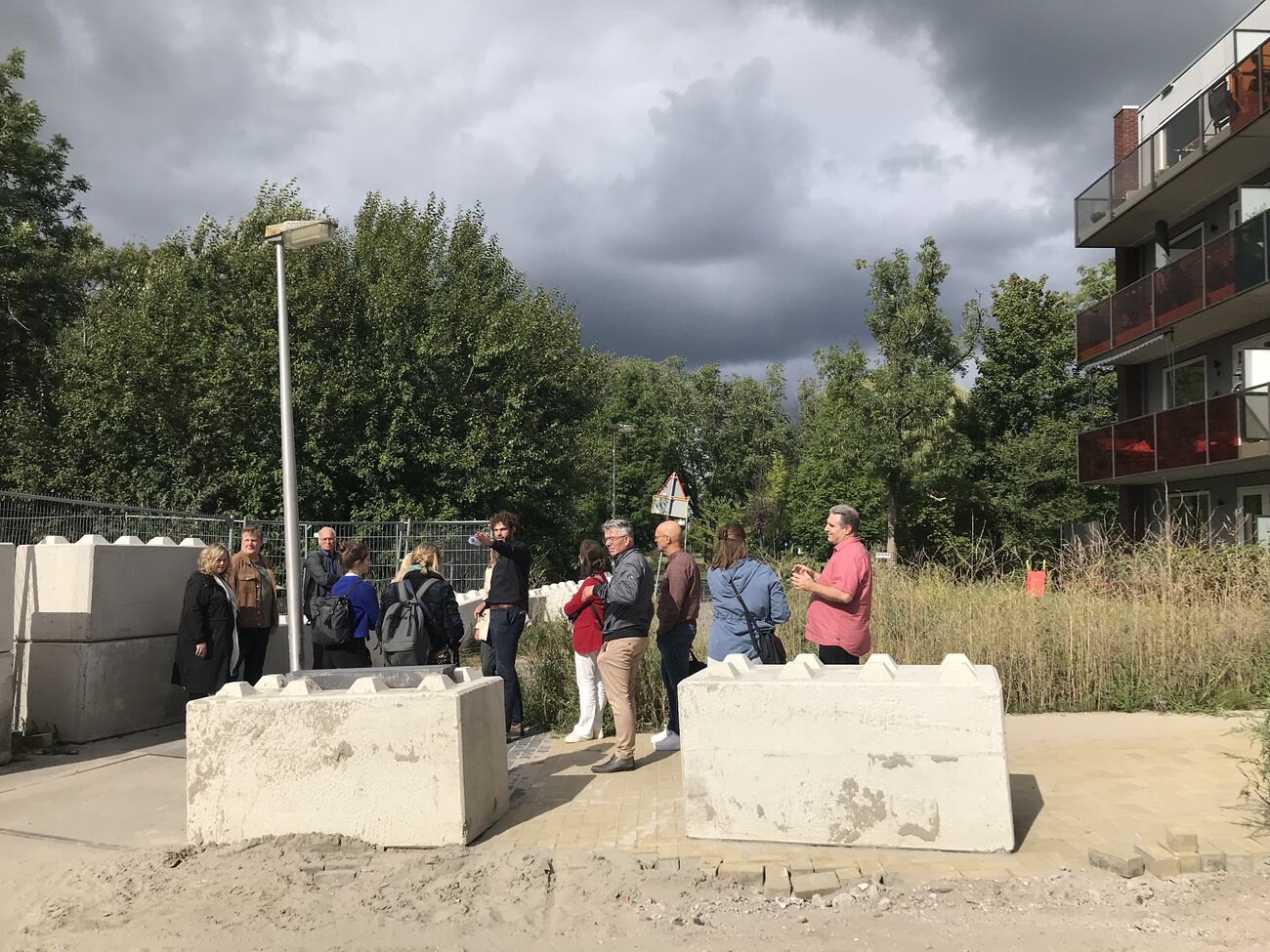
City Deal Summer Tour, 2022, Purmerend, Photo: AWB

Where do we make space for trees? How do we consider future heat networks in our spatial plans? Which types of collaborations are needed between municipalities, the state and network operators? In City Deal Public Space we try to answer questions like these.

This project helps us evolute from a range of ad hoc solutions to one coherent approach for our public space and its foundation, in alliance with Dutch ministries, municipalities, knowledge institutes and public utilities. After two years of City Deal Public Space the contours of a common narrative are starting to become clear.

In City Deal, AWB has taken on the role of ‘Atelier Master’, organising ateliers and meetings. The different development teams gather to question each other and share their perspectives. There are also 16 case studies involved in City Deal, coming from the municipalities in which the need for a new, integrated approach is highest.

During the summer, the participants of City Deal gathered in the municipalities of Purmerend, Zoetermeer, Amersfoort, and Groningen. During these ‘summer tours’ local cases embodied the spatial challenges that we are facing. How can Groningen, for example, initiate the conversation about a new street design with inhabitants and designers? Which actors need to get together in Zoetermeer for a joint cost-benefit analysis on the redesign of a neighbourhood? How to you take social issues into account when redesigning a district?

Case studies like these will be looked at on the next atelier on the 8th of December. All City Deal partners will head to Utrecht to gather the first results of the various development teams, bringing together the pieces of the public space puzzle.

More News
EN FR NL
WORKROOM

Since 2010, Architecture Workroom Brussels has focused on the future of our living environment. The organisation began as a safe haven to address the link between space and societal transitions, aimed at fostering a futureproof design practice, commissioning and building culture.

It has now become evident that the transformation of our streets, neighbourhoods, and landscapes is both a prerequisite and a lever for achieving societal goals in synergy. Yet we observe that these transformations remain difficult to imagine and implement. They span so many sectors and involve so many actors that responsibility falls on everyone, and therefore, ultimately, on no one.

That is why we make it our mission to create the space that connects them. And with this refined mission comes a new name: WORKROOM, House for transformation. WORKROOM is the shared space where the future of our living environment is not only imagined but also organised.

We are currently taking the lead on three mission-driven transformations:

  • SOCIETAL INCUBATORS - By 2030, stakeholders from the youth, culture, sports, care and education sectors will join forces to create renewed societal spaces that tackle loneliness and counteract the fragmentation and pressure on public infrastructure.
  • FOSSIL-FREE NEIGHBOURHOODS - By 2030, at least ten neighbourhoods will be underway with the transition to fossil-free energy in an inclusive and affordable way, with a view to completely phase-out fossil fuels by 2040.
  • SPONGE LANDSCAPES - By 2030, we will have achieved our water, agriculture and nature goals through a single, coherent approach at catchment area level, in which strong regional coalitions collectively enhance the landscape's sponge capacity.

To make these transformations a reality, WORKROOM works shoulder to shoulder with pioneering designers, local authorities, organisations and businesses, governments, knowledge institutions and impact investors.

Through co-creative design, we imagine shared pathways to the future in exhibitions, publications, innovation programmes and public programmes. These are the workrooms where we connect the actors capable of realising these transformations. From there, we design shared ownership and the organisational, funding and policy models that lead to real change.

The name is simpler. The stakes are higher. WORKROOM is the shared space where we tackle the social and spatial transformations that no one can achieve alone. In an era of polarisation, compartmentalisation and instability, that is perhaps the most radical thing we can do.