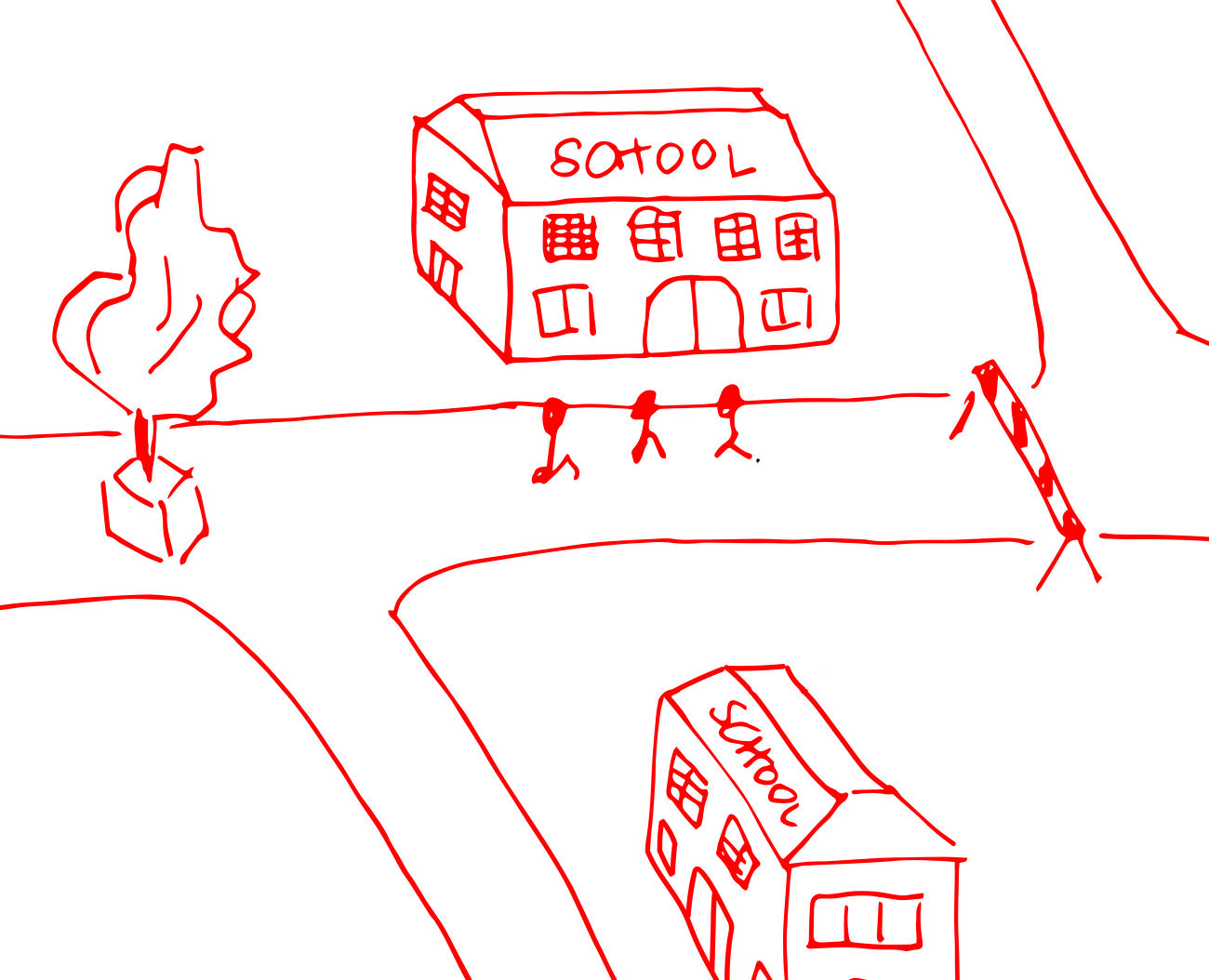
The starting point of a liveable city is to guarantee the health and safety of the most vulnerable people: schoolchildren. That is why, together with Citytools and Filter Café Filtré, we are supervising the implementation of School Streets in different places in Brussels, in commission of the City of Brussels. This year, we use the Week of Mobility (16-22 September) to put School Streets in the spotlight and on the agenda.

By introducing a School Street in a school environment, busy traffic is limited as much as possible. It also encourages pupils, parents and staff to go to school in an active way. This is healthy for the children, good for the air quality and makes it a lot quieter and safer at the school gates in the morning and evening.

We are now launching the first tests with School Streets! On Monday 23 August the test phase started in the Vlaamsesteenweg: two large planters stop motorised traffic coming from the smaller Ringroad. In the long term, the Vlaamsesteenweg, the Sleutelstraat and the Oppemstraat will become traffic-free streets. The test should determine whether the part of the Vlaamsesteenweg between the Sleutelstraat and the Nieuwpoortlaan can become a dead end, so that the intersection with the Small Ring becomes safer.

On 16 September, on the eve of Mobility Week, we will launch the second test in Dageraadstraat. There, we will close Dageraadstraat to motorised traffic every morning and evening on weekdays for three months. If this test proves successful, Dageraadstraat will also become a School Street in the long term.

Take a look at one of the test environments during the Week of Mobility! During this week, we would also like to focus on multiplying these first initiatives. In several school districts, we organise walks with schools. Together with them, we explore what interventions can make the school environments safer and healthier School Streets. In this way, together we take steps towards a long-term vision for School Streets on the scale of the whole city.

More News
EN FR NL
WORKROOM

Since 2010, Architecture Workroom Brussels has focused on the future of our living environment. The organisation began as a safe haven to address the link between space and societal transitions, aimed at fostering a futureproof design practice, commissioning and building culture.

It has now become evident that the transformation of our streets, neighbourhoods, and landscapes is both a prerequisite and a lever for achieving societal goals in synergy. Yet we observe that these transformations remain difficult to imagine and implement. They span so many sectors and involve so many actors that responsibility falls on everyone, and therefore, ultimately, on no one.

That is why we make it our mission to create the space that connects them. And with this refined mission comes a new name: WORKROOM, House for transformation. WORKROOM is the shared space where the future of our living environment is not only imagined but also organised.

We are currently taking the lead on three mission-driven transformations:

  • SOCIETAL INCUBATORS - By 2030, stakeholders from the youth, culture, sports, care and education sectors will join forces to create renewed societal spaces that tackle loneliness and counteract the fragmentation and pressure on public infrastructure.
  • FOSSIL-FREE NEIGHBOURHOODS - By 2030, at least ten neighbourhoods will be underway with the transition to fossil-free energy in an inclusive and affordable way, with a view to completely phase-out fossil fuels by 2040.
  • SPONGE LANDSCAPES - By 2030, we will have achieved our water, agriculture and nature goals through a single, coherent approach at catchment area level, in which strong regional coalitions collectively enhance the landscape's sponge capacity.

To make these transformations a reality, WORKROOM works shoulder to shoulder with pioneering designers, local authorities, organisations and businesses, governments, knowledge institutions and impact investors.

Through co-creative design, we imagine shared pathways to the future in exhibitions, publications, innovation programmes and public programmes. These are the workrooms where we connect the actors capable of realising these transformations. From there, we design shared ownership and the organisational, funding and policy models that lead to real change.

The name is simpler. The stakes are higher. WORKROOM is the shared space where we tackle the social and spatial transformations that no one can achieve alone. In an era of polarisation, compartmentalisation and instability, that is perhaps the most radical thing we can do.