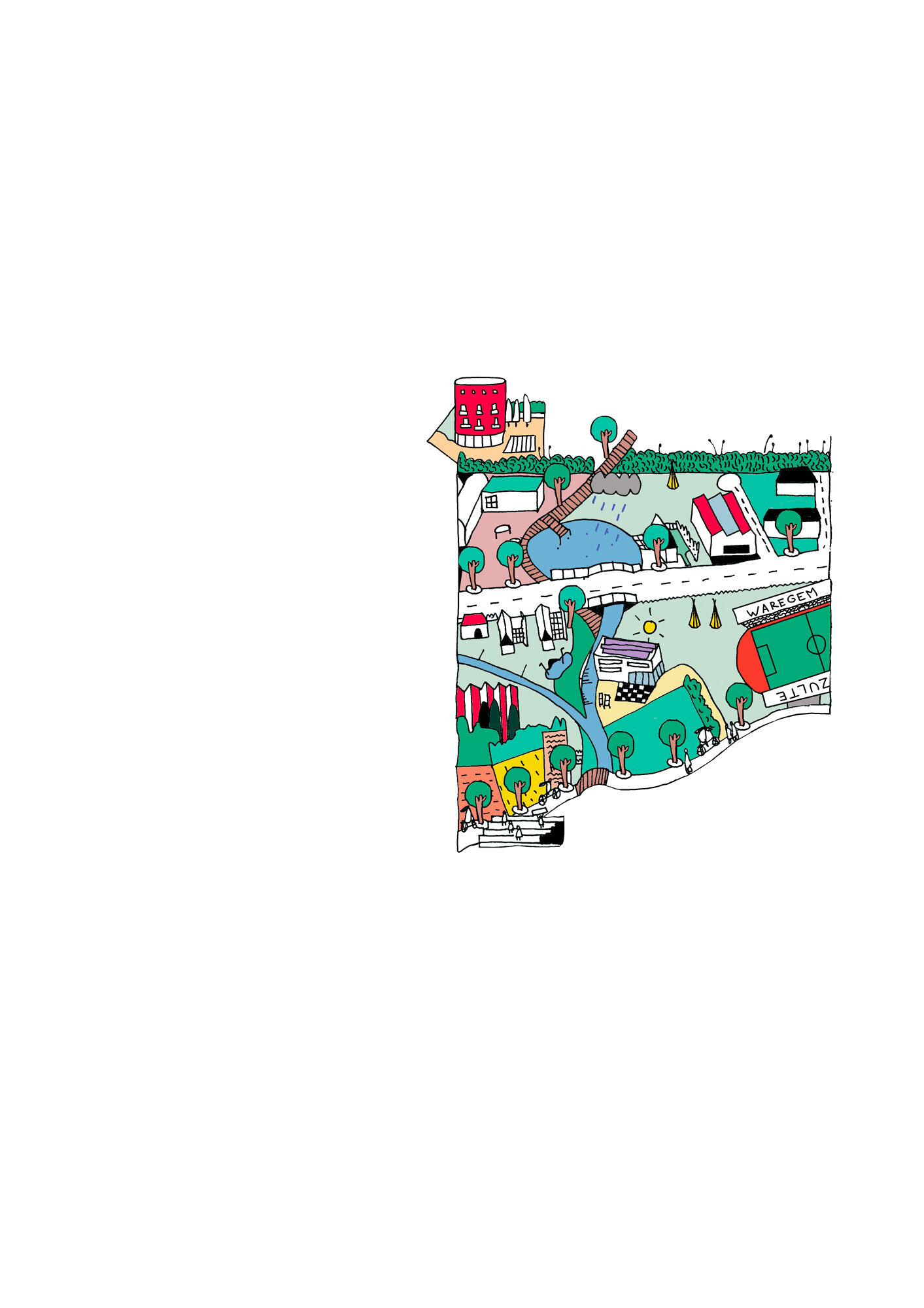
Intercommunal Leiedal is working on the regional vision for the Kortrijk region. The city around which the region is situated currently receives enough attention already, but the smaller municipalities around it do not necessarily benefit from projects implemented in the city. As a result it is necessary to set up projects specifically for these places.
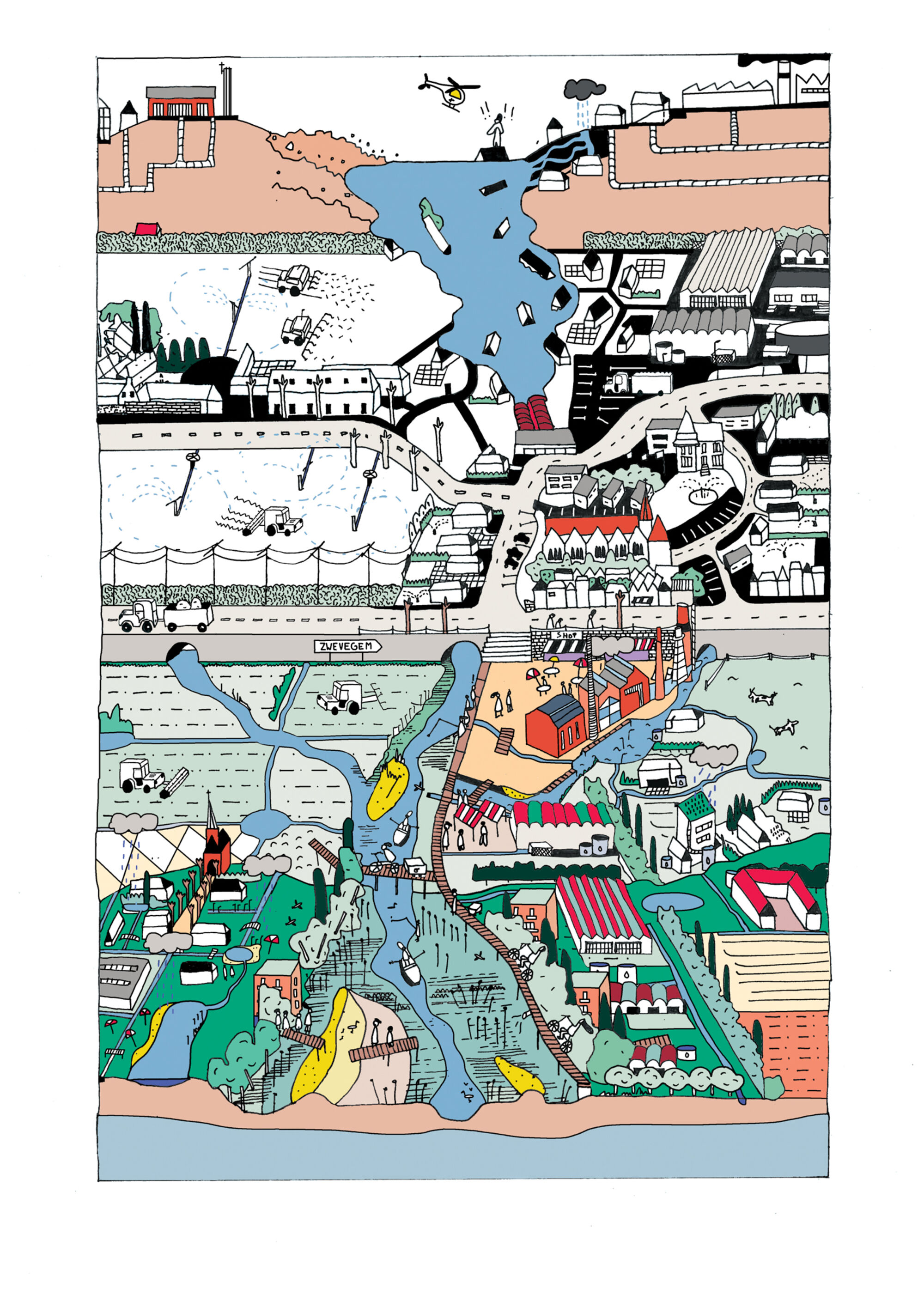


Architecture Workroom Brussels sought ways of linking spatial ambitions to the objectives within the ambitions and broad lines of the regional vision for Kortrijk.
The ambitions are to make the region climate neutral, space neutral, accessible and local, with no borders, or delimited, and liveable. The objectives applied include a resilient blue-green network, reinforcing centres and the urban network, and activating productive landscapes. The objectives bundle a number of ambitions. Architecture Workroom Brussels strives to incorporate these three objectives in different environments and thus create connections or connecting spatial concepts.
Connection 1: A robust water system
The problems the region faces are flooding, erosion, agriculture that consumes a lot of water, and surfacing. By implementing a robust water system you reinforce the green-blue network, make agriculture more productive and create better quality living environments.
Connection 2: A sustainable blue energy landscape
Over the years the water system has also resulted in urbanisation. How could the urbanisation now be supplied with energy in a sustainable manner? It seems logical to use the water that is available to achieve this. For example, for the heating grid, water can be used to cool, but water is also able to transport heat.Possible new activities involve using public space as a lever for transforming residential districts and using farming as part of circular energy. In this connection the focus is on the link between urbanisation, the water network and energy.
Connection 3: A structural blue-green network
Surfacing and parcelling goes on. As a result green space is enclosed in and between building blocks. This means the green space must urgently be made more interesting and useful. Consequently urbanisation must become more porous. Urbanisation must not impede the landscape's absorption capacity – this is what happens when the soil is no longer able to absorb. For example, green spaces can also serve to cool paved areas. The connection that is key to this link is the one between urbanisation, the water system and the green network (biodiversity).
Connection 4: A connected food-housing landscape
It is important to restore the connection between food production and the city dweller. This could be achieved by diversifying farming in the suburbs (in contrast to monoculture). It can coexist alongside large-scale farming, and the diversity can serve as a springboard between farming and the city, with small-scale initiatives such as farmers' markets that try and build a bridge between what is produced in the suburbs, and the city. This means the environment also becomes more interesting from a recreational perspective, which may serve as a challenge for rezoning vacant farms.
The public brochure 'Contrei. Collaborating on a region in transition' depicts these four connections in a number of local and thus recognisable landscapes. In addition the challenges that crop up throughout the region as a whole were examined. This produces a sustainable development framework for the entire region when the maps are placed one on top of the other.