About
Collaborator

Chiara Cicchianni
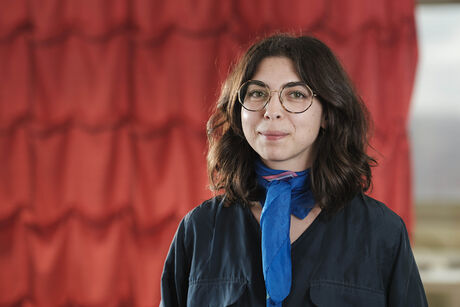
Chiara Cicchianni (she/her) applies her background in urban planning, spatial analysis, and policy design to explore how societal infrastructures and community practices can enable just and sustainable transitions.  She has also been focusing on the complex question of the energy transition at the district level. She has been part of Architecture Workroom Brussels since 2018, where she works on projects that connect research, design, and governance, often through speculative mapping, drawing, and storytelling. 


Within Workroom, Chiara has contributed to a wide range of transition-oriented projects related to healthy foodscapes, circularity, energy, and broader societal transformations. She has been involved in international and local research trajectories such as the North Sea Port District, Circular (City) Ports, Urbanising in Place, and JPI Cities4PED, and was part of the curatorial team of the recent exhibitions and debate settings Prefiguration and Operation Energy Neighbourhood.


Since 2023, Chiara has also been a teaching assistant at the Faculty of Architecture, KU Leuven. She studied at Tongji University in Shanghai and at Politecnico di Milano, where her master’s thesis examined the role of transformative welfare services and public space in supporting community-led processes of urban regeneration.


Selected projects:

• Brussels Urban Landscape Biennale (2018) 
• Circular (City) Ports (2018 – 2020) 
• Towards and agroecological urbanism  (2018-2022) 
• JPI Cities4PEDs / PED toolkit  (2021–2023) 
• Prefigurations (2022) 
• Future Generations Lab, Stadhuis Leuven (2023-2024) 
• Guide to accelerate the energy transition in existing urban neighbourhoods and village centres (2024) 
• Operatie Energiewijken  (2024–2025) 
• Learning Environment Societal Infrastructure

EN FR NL
WORKROOM

Since 2010, Architecture Workroom Brussels has focused on the future of our living environment. The organisation began as a safe haven to address the link between space and societal transitions, aimed at fostering a futureproof design practice, commissioning and building culture.

It has now become evident that the transformation of our streets, neighbourhoods, and landscapes is both a prerequisite and a lever for achieving societal goals in synergy. Yet we observe that these transformations remain difficult to imagine and implement. They span so many sectors and involve so many actors that responsibility falls on everyone, and therefore, ultimately, on no one.

That is why we make it our mission to create the space that connects them. And with this refined mission comes a new name: WORKROOM, House for transformation. WORKROOM is the shared space where the future of our living environment is not only imagined but also organised.

We are currently taking the lead on three mission-driven transformations:

  • SOCIETAL INCUBATORS - By 2030, stakeholders from the youth, culture, sports, care and education sectors will join forces to create renewed societal spaces that tackle loneliness and counteract the fragmentation and pressure on public infrastructure.
  • FOSSIL-FREE NEIGHBOURHOODS - By 2030, at least ten neighbourhoods will be underway with the transition to fossil-free energy in an inclusive and affordable way, with a view to completely phase-out fossil fuels by 2040.
  • SPONGE LANDSCAPES - By 2030, we will have achieved our water, agriculture and nature goals through a single, coherent approach at catchment area level, in which strong regional coalitions collectively enhance the landscape's sponge capacity.

To make these transformations a reality, WORKROOM works shoulder to shoulder with pioneering designers, local authorities, organisations and businesses, governments, knowledge institutions and impact investors.

Through co-creative design, we imagine shared pathways to the future in exhibitions, publications, innovation programmes and public programmes. These are the workrooms where we connect the actors capable of realising these transformations. From there, we design shared ownership and the organisational, funding and policy models that lead to real change.

The name is simpler. The stakes are higher. WORKROOM is the shared space where we tackle the social and spatial transformations that no one can achieve alone. In an era of polarisation, compartmentalisation and instability, that is perhaps the most radical thing we can do.